
17.08.2026 r.
Author: Viktor Nedvyja
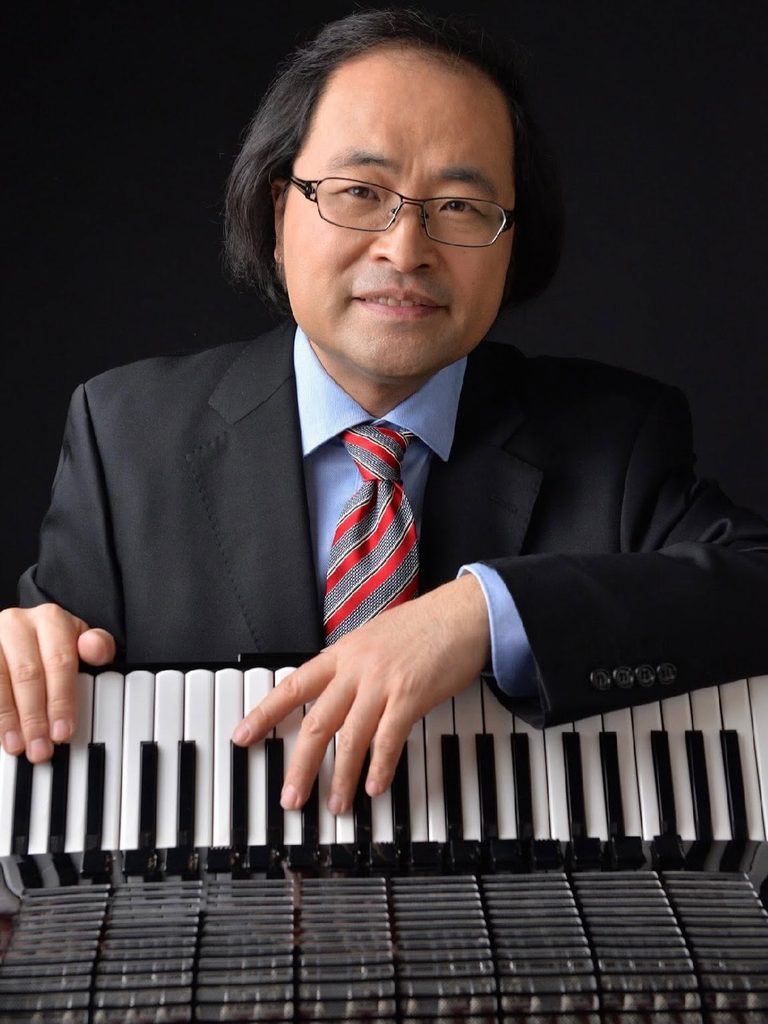
We are in Riva del Garda as part of the Musica Riva festival, where we have a unique opportunity to speak with Professor Cao Xiao-Qing during his masterclass. This special event became possible thanks to the initiative of maestro Mario Stefano Pietrodarchi, who invited the professor to share his experience and knowledge with students from different countries.
Such masterclasses, like this one in Riva del Garda, create opportunities for the meeting of different musical traditions and pedagogical schools. In your opinion, what is the significance of international exchange of experience for the development of young musicians and the future of the accordion?
For Chinese young students, coming to such events has a very important meaning, because they can learn more about European culture. For our young generation, it is very beneficial to start seeing musical life in Germany, Italy, and generally in Europe early on, because classical accordion in China is a relatively new instrument. It is not a traditional instrument like some other Chinese instruments, but we are trying to write a new Chinese history of the accordion for future generations, as we do not have a long history of this instrument in China. At the same time, this gives European teachers, students, and audiences an opportunity to learn more about the work of the new generation of Chinese students, accordionists, and composers.
Looking back at your long career as a performer and educator, which events or people have had the greatest influence on shaping your musical and pedagogical vision?
Particularly important for my formation was that personally, 30 years ago, I became the first Chinese accordion student to go to Europe to study. I believe that in today’s world, mutual understanding and mutual respect are most needed, a deep awareness and study of one’s own art and culture, but at the same time, it is also important to learn about the most significant cultural and artistic achievements of other nations and countries. As an accordion teacher and former student, I particularly emphasize that in the learning process, one should not be limited exclusively to the European tradition. Our students must absorb the best world experience, which we as educators, in turn, should supplement, relying on their individual strengths. I believe this provides the opportunity to create a new, fresh musical style that can surprise.
I want to show my students not only the typical Chinese style of playing the accordion, and not just copy the German or Italian style. It is important how they combine and digest knowledge to create something special. It is very important to have an open mind and open eyes to everything, and then conceptualize it. What I most wish to see in my students is how they understood and digested the acquired knowledge, and how they then expressed it through new creative ideas.
Thank you for such a wonderful answer. The next question concerns China. China today is one of the leading countries in the field of music accordion education. What factors, in your opinion, became key in such rapid development of the Chinese accordion school?
Many young Chinese accordionists reach an extremely high level at a very early age. What features of the Chinese music education system allow them to achieve such results, in your view?
In my opinion, the most important thing is that China now openly welcomes different cultures, and also allows young people to go abroad to experience the world. In addition, China now has a 30-day visa-free regime for citizens of dozens of countries, which particularly facilitates cultural exchanges.
In China, there is a wonderful atmosphere in which children and teenagers study music, art, and various knowledge. In addition, parents actively support this. They start taking children to various music classes or sports clubs very early so that children can get acquainted with these skills as early as possible. In China, there is a popular saying: 'A day’s planning starts in the morning, a year’s planning starts in the spring.’ For children, the most important thing is to find opportunities for development precisely at an early, adolescent, or even childhood age. There is also a popular position among parents: 'We did not have such good opportunities in our childhood, so now we want to give more to our children.
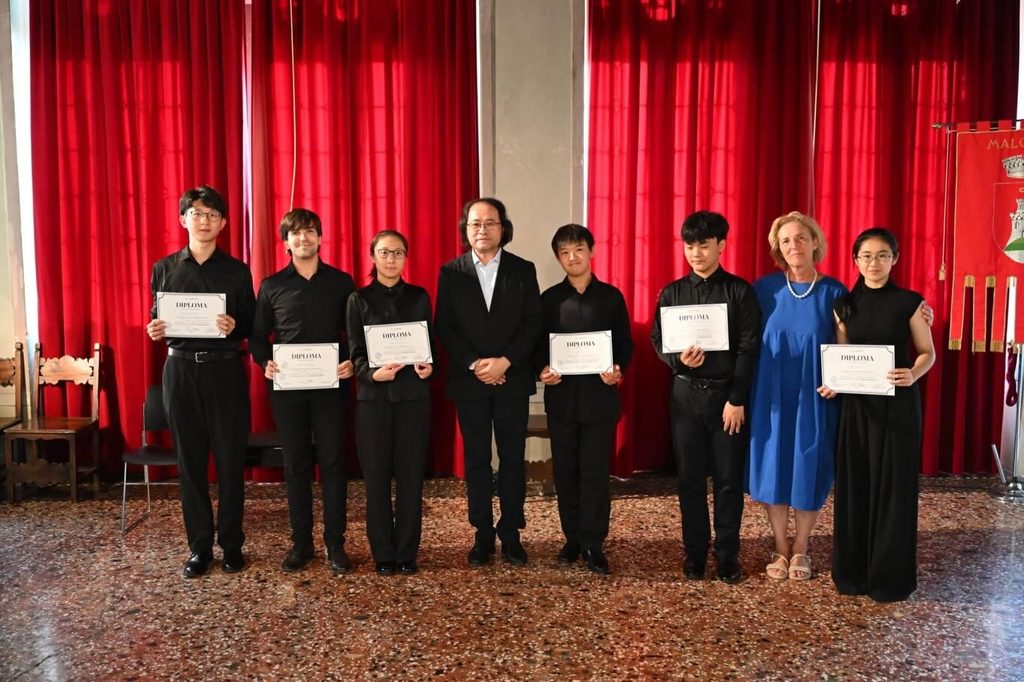
(photo: facebook.com/MusicaRivafestival)
I think many readers will be interested to know how the system of music education is structured in China. That is, are there public music schools, colleges, conservatories, or is the learning process somehow integrated into the conservatory?
In every city there are different primary music schools and music schools. In very important cities there are conservatories, each of which has middle music schools attached to it (MICE) for children aged 12 to 18. Such schools have colossal competition because they recruit very few students each year. For example, in such a school in Beijing, only three accordion students are accepted into my class each year. After that, they enter the conservatory, where study lasts 4 years for a bachelor’s degree, then 3 years for a master’s, and another 3 years for a doctorate. That is, if a student successfully completes this entire path, the full cycle of study is 13 years.
This special professional accordion class prepares people for a professional future – this is your future job, you must become a professional musician. Unlike students of regular schools or gymnasiums who can choose medicine, philosophy, or physics after graduation, in music it is different. At 12 years old you must already clearly know what you want, but 12 years is not even the beginning. To enter such a middle music school, you must start playing at 6 or 7 years old. Upon admission at 12, children face huge competition and exams: about 100 applicants come, and only the 3 best get the opportunity to study.
We usually hold exams for young people in January or February. The exam at the conservatory takes place in two rounds. In the first round, they play their program. After that, half are eliminated, and the best remain. Next, they check knowledge of music theory and development of musical ear to understand the child’s musical abilities. In the second round, they play again, but a different program. A great many young people want to study with us. We have many students, and not only in accordion – for example, 20 people are accepted on piano per year, there are more professors, and 10 or 15 people for other instruments. Every year about 150 new students enter our college. Therefore, it is very important to start from early childhood. Starting later is already very difficult, because other children develop incredibly fast.
You showed your very interesting method books for children learning to play both on the C-griff and on the B-griff. What inspired you to create these materials and what main principles did you embed in this methodology?
For instruments like the piano, violin, and others, very good and extensive teaching systems or different textbooks exist. For us, for the free-bass accordion, there were initially very few such materials. At an early stage, I myself often used many textbooks for the piano and practiced with them. But later I saw that many young people need specialized teaching materials specifically for the accordion. Therefore, I began to create them.
My books teach playing on C and B systems with the head, not just fingers. The first stage is to teach students to see the instrument and notes correctly. Here, for each scale, for example, the C-system, not only the fingering is precisely detailed, but also the visual layout of the sounds, because some books only give fingers. I want the student to see and understand the fingerboard, because some people play by ear but do not read sheet music fast enough. My next step is etudes for studying scales, chromatic bass, chords, and various technical techniques. There shouldn’t be just a few options, there should be 30, 50, or 100 different ones. Separately, there should be collections for children under 12 years, separately – under 18 years, and then – high-art etudes of a high level, like Chopin’s etudes, which can be performed in concerts. These should be not just exercises for the fingers, but real, beautiful music. This is my next step in my work.
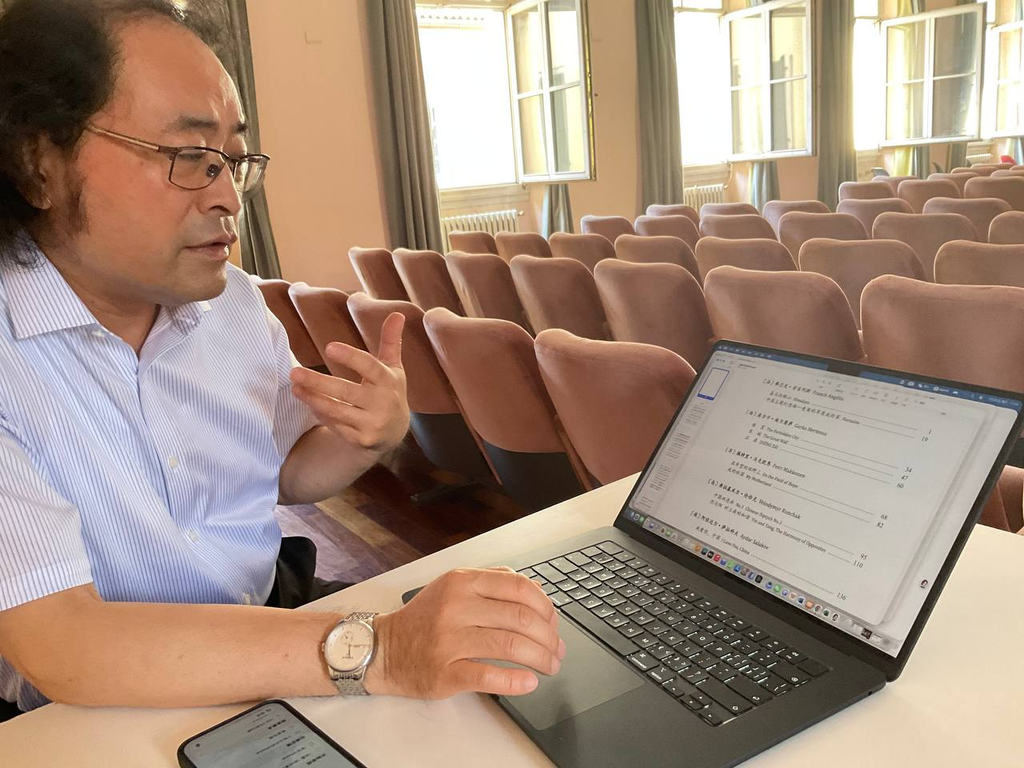
(photo: Viktor Nedvyha)
Are you considering the possibility of translating these publications into other languages so that they could be accessible in different countries?
Yes, I have an idea to translate my teaching materials into different languages so that publishers in Europe can also publish these textbooks. This is the first case in China when textbooks for the free-bass accordion for the C-system and B-system are published and distributed simultaneously. In addition, about 10 years ago I began working with my good friends and fellow composers. I had the idea to give European composers Chinese melodies and themes as a basis. They created works at their own discretion, but the initial idea and theme came from China – such collaborations were made with Gorka Hermosa, Petri Makkonen, Volodymyr Runchak, and others.
Your students regularly demonstrate extraordinary results at the most important international competitions, while they stand out not only for their technical mastery but also for their very original choice of repertoire and mature musical thinking. How do you help young musicians form their own artistic voice?
In our class, there is a wonderful atmosphere of mutual understanding in learning. In addition, in our institute, we cooperate and exchange experience a lot with musicians who play other instruments. Students have the opportunity to absorb the experience of playing other instruments and use the resources of different schools and departments, which greatly contributes to their artistic growth. Our conservatory is leading in China. Students enter the professional musical environment very early, which helps them form an awareness of exactly how they need to study. Parents also actively support my work, thanks to which a very positive creative cycle arises.
In addition to individual lessons, we conduct regular general classes in the form of concert-auditions every week. This helps students develop stage awareness and gives them a regular opportunity to perform. Every week during the semester we hold such performances, where students show new or old works. They play solo or chamber music, showing their results every week, and although maintaining such a pace every week during the semester is not easy, it brings wonderful fruit.
I founded the accordion class at the Beijing Conservatory in 2004. Before that, we had no department or class of accordion in the conservatory at all, and I became the first professor of accordion here. This class is about 20 years old. I organize these weekly open lesson-concerts on my days off, because on Saturday and Sunday everyone is free. I give my personal free time to the students. From Monday to Friday, I conduct official individual lessons, and on weekends we gather for these informal but extremely important joint concert-seminars. If someone has even one work or part of the program ready, they go out and play in front of everyone. This develops the rhythm of professional life. Our students learn to master the material quickly: not to dissect one work for a whole month, but to learn a new piece in a week. They constantly see each other’s performances and continue to develop. Of course, there is rivalry between them, but it is a positive competition that gives additional strength for learning.
How do you assess the future of the accordion as a concert instrument? What development directions do you consider most important for the coming decades?
The history of the accordion is quite short, so on the one hand, we continue to write and supplement important materials that need reinforcement, such as textbooks or numerous educational materials for laying the foundation in students. On the other hand, we also must keep up with the demands of the times for music, providing everything that the accordion can express. I am full of optimism about this, but for this, the joint efforts of all colleagues in the international environment are important to us.
Since this interview is intended primarily for a Polish audience, when you think of the Polish accordion school, which names, events, or features of this tradition first come to your mind, and how do you evaluate its place in the modern international accordion environment?
In China, there is wide recognition and respect for the Polish musical school and art. Regarding the accordion, we are familiar with the work of the Warsaw Accordion Quintet, as well as numerous works and performances of the new generation, in particular composition works, for example, by Krzysztof Penderecki.
In conclusion, I would like to ask about your plans for the near future. What new pedagogical projects, publications, concerts, masterclasses, trips, or jury work at competitions await you in the near future?
Many accordion competitions are held in the second half of the year. In the second half of the year, I plan to participate in the jury of the competition in Castelfidardo. Also in the plans are competitions in France – 'Trophe Mondial’, and in Arrasate in Spain. Parallelly in China, preparations are underway for the publication of a collection of works for the accordion, original concertos and chamber music by Chinese composers.
On behalf of the editorial office of akordeon.info and from me personally, I want to sincerely thank you for your time, for this conversation, and for the opportunity to share your extensive experience with our readers. It is a great honor for us to have the opportunity to talk with a musician and educator who has made such a significant contribution to the development of accordion education in the world. We wish you further creative success, inspiration in your pedagogical projects, and new meetings with young musicians from all over the world.
Thank you. I am very glad to meet you at the masterclass and do a lot of interesting things with you, so through this interview, I also want to convey to all accordion friends in Poland and beyond my warmest greetings and wishes.
Dodaj komentarz